
How to Identify a Plant by Leaf Picture: Taking the Photo and Checking the Match
A single leaf can be enough to put a name to a plant, but only if the picture is clear and you know which features the species description depends on. Recognition software and human experts both work from what the photo shows, so a cropped, blurred or damaged leaf leads to weak answers. This guide explains how to take a usable leaf picture. It then works through two examples where published descriptions give you something specific to check: a spiny shrub whose leaves resemble an oak, and the clover group, where an extra leaflet can mean a rare variant or a different plant. It ends with the common mistakes and the point at which you should hand the question to an expert.
Quick answer: Take a sharp, uncropped picture of one intact, typical leaf, run it through a reference or recognition tool, and treat the result as a candidate. Confirm it with any check the species description gives, and ask an expert when the photo cannot settle the question.
What a leaf picture can and cannot tell you about a plant
A leaf is often the only part of a plant you have in hand, which is why so many identification attempts begin with one. A photo of it records a shape, an edge, a surface and sometimes coloured markings, and both recognition tools and people read those traits from the image. For background on outlines, lobes and other shape terms, see how to identify a plant from its leaf shape.
The limits matter as much as the clues. Leaves vary on a single plant, young growth can look different from mature growth, and torn or chewed leaves lose their shape. Unrelated plants can also end up with similar-looking leaves. Oakleaf holly is a clear case. It belongs to the holly family, Aquifoliaceae [1], yet its name comes from a leaf whose shape resembles that of certain oak (Quercus) species [1]. A name chosen on the silhouette alone could put it in the wrong family.
Leaves divided into separate leaflets cause a similar problem. White clover, Trifolium repens L [2], normally carries three leaflets, and a leaf with four leaflets instead of three [2] is an occasional form of the same species. A different plant, Oxalis tetraphylla [2], bears four leaflets as a matter of course. A single cropped picture of a four-part leaf may not be able to say which of these you are looking at.
Treat any name drawn from a leaf picture as a strong lead rather than a verdict. The sections below show where the reference descriptions give you something specific to check, and where only a specialist can close the gap.
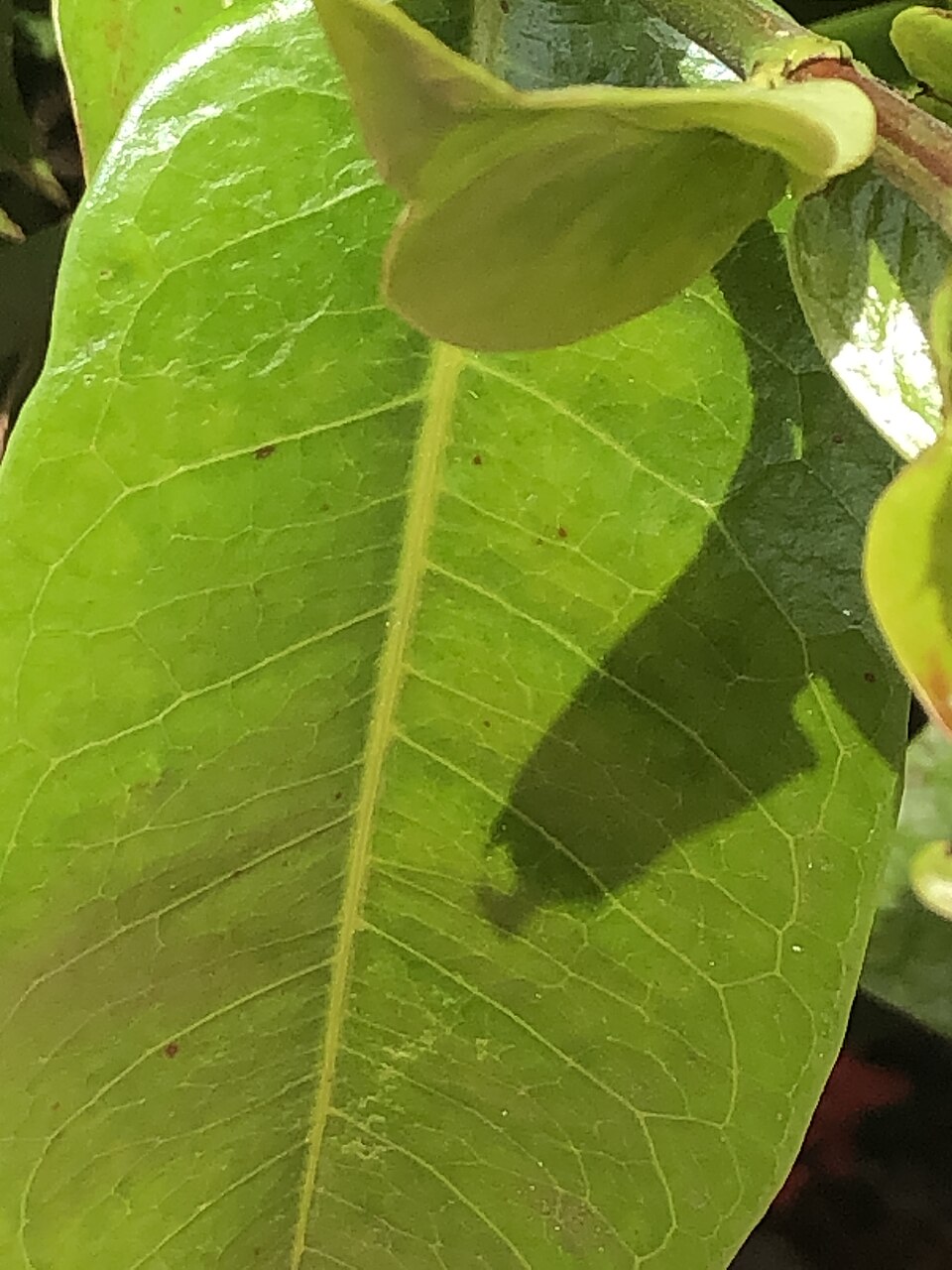
How to take a leaf picture that can be identified
Many failed identifications trace back to the photograph rather than the plant. The aim is to give whoever reads the picture, a person or a recognition tool, a clear and complete view of the leaf.
Steps that help:
- Choose an intact leaf from the middle of a stem, not the smallest new shoot or a worn leaf near the base.
- Show the whole leaf from tip to stalk, with nothing cut off at the edge of the frame.
- Lay or hold it against a plain, contrasting background such as a sheet of paper.
- Shoot in even daylight and keep your own shadow off the leaf.
- Hold the camera parallel to the leaf so it is not foreshortened, and tap to focus before you shoot.
- Gently brush off dust, soil or water droplets that sit over markings or the edge.
- If the leaf is made of several parts on a shared stalk, keep all of them in frame and not overlapping.
- Take two or three shots and keep the sharpest.
Tip: Before pressing the shutter, think about which feature the description of a likely candidate depends on, and fill the frame with it. For a spiny, holly-like shrub that is the edge, because its description calls for a serrated margin with 3-5 pairs of prominent spines [1]. For a clover-type plant it is the centre of each leaflet, where the reference describes the red fleck mark and red midrib [2].
Avoid filters, heavy digital zoom and edited colours. A recognition tool reads only what the frame contains, and a colour filter or a smeared, zoomed image changes what it sees. If your phone has a close-up mode, use it for edge detail, but keep a normal shot of the whole leaf as well so the picture still shows the full shape.
Write a short note to go with the photos: where the plant was growing, whether it was planted or appeared on its own, and whether it was indoors or outdoors. That context costs nothing to record now and is hard to reconstruct later if you need a second opinion.
With a clear set of photos, you can try free web tools. Their options and trade-offs are covered in identify plant by picture online free, and a broader walk-through is in identify plant online.
Reading the edge: the oakleaf holly example
Oakleaf holly shows why the first impression from a leaf picture can mislead. The plant is a holly in the family Aquifoliaceae [1], and the cultivar 'Conaf' is described with a 3.5 inch oak shaped leaf [1]. Its name comes from that likeness to the leaves of certain oak (Quercus) species [1]. Anyone glancing at a photo could easily say oak.
The extension description gives a specific feature that points the other way: the margins are serrated and carry 3-5 pairs of prominent spines [1]. To use that from a picture:
- Photograph the leaf flat and from directly above, so the edge is not tilted away from the lens.
- Enlarge the margin in the saved picture and look for the serrations and spines the description mentions.
- Note how many pairs you can see and whether that fits the 3-5 pairs of prominent spines described [1].
- If the margin is torn, curled or out of focus, choose a different leaf and shoot again.
In a photo, spines can disappear when the edge curls toward the camera or flat light hides the outline. If several retakes still leave the edge unclear, stop there and pass your photos to an expert rather than guessing from a blurred margin. When you pick a leaf to photograph, wear gloves, since the description calls the spines prominent.
Margins are also the part of a leaf most often damaged by insects and weather. A leaf with ragged or missing edges can no longer show its spines, so pick an intact one. If damage is widespread across the plant and you want to know the cause, how to identify holes in garden plant leaves covers the usual culprits.
If a recognition tool suggests an oak for a spiny evergreen leaf, this margin check is the one to apply before you accept the name.
Clover and its four-leaflet look-alikes
Clover is the familiar example of a leaf divided into separate leaflets on a shared stalk. White clover, Trifolium repens L [2], carries three leaflets as standard. A leaf with four leaflets instead of three [2] is an uncommon form of that same plant, not a new species.
That sets a practical trap. Oxalis tetraphylla [2] is a separate plant that bears four leaflets routinely, so a four-part leaf in a picture could belong to either. One close-up of one leaf rarely carries enough information to separate them.
The reference material describes three approaches people have used with clover:
- Scanning the patch. One expert's technique was to look across whole clover patches for breaks in the repeating pattern, because three-leaflet leaves read as triangles and four-leaflet leaves read as squares [2]. For your picture, that means photographing a stretch of the patch as well as the single leaf, so the surrounding leaves are on record.
- Looking for markings. Note whether the leaf shows the red fleck mark and red midrib, a bold red herringbone streak running down the centre of each leaflet [2]. These details are lost in a distant or low-resolution shot, so photograph them close up and in even light.
- Genetic testing. In a laboratory, molecular markers can now detect whether a plant carries the gene for four leaves [2]. That is a specialist test, not a home one, but it explains why an expert can sometimes give a firmer answer than any photograph.
None of these gives a name on its own. What they do is give a tool or an expert far more to work with than a single leaf with an unusual number of parts, and they make it less likely that a rare variant is mistaken for a different plant, or the reverse.
Side-by-side comparison of the example plants
The table gathers the worked examples so you can see what the references describe for each one and which first impression tends to mislead.
| Plant | Family or group | What the reference describes | What can mislead |
|---|---|---|---|
| Oakleaf holly 'Conaf' | Aquifoliaceae [1] | Serrated margin with 3-5 pairs of prominent spines and a 3.5 inch oak shaped leaf [1] | Oak-like outline |
| White clover, Trifolium repens L [2] | Clover | Three leaflets, occasionally four leaflets instead of three [2] | A single four-leaflet leaf |
| Oxalis tetraphylla [2] | Oxalis | Four leaflets [2] | Resemblance to a four-leaf clover |
Read across each row. For the holly, the 3.5 inch oak shaped leaf [1] suggests an oak, while the 3-5 pairs of prominent spines [1] fit the holly description. For white clover, three leaflets is the usual form and four is an occasional variant of the same species. For the oxalis, four leaflets is its normal state. That overlap is why a picture of one four-part leaf is not enough, and why the patch view and the red fleck mark and red midrib [2] are worth recording.
In each row, the feature people notice first is the one most likely to mislead. The feature that matters usually needs a closer, sharper picture.
Common mistakes that lead to the wrong plant name
Wrong identifications usually come from a handful of repeat errors:
- Trusting the silhouette alone. The oak-shaped holly shows how a familiar outline can point to the wrong family.
- Photographing an untypical leaf. Seedling leaves, shade-grown leaves and damaged leaves can look unlike the plant's usual form.
- Cropping the edge. A tight close-up that cuts off the margin removes the spines you may need [1].
- Treating one unusual leaf as a new plant. Four leaflets instead of three [2] can appear on white clover.
- Assuming every four-part leaf is clover. Oxalis tetraphylla [2] is a different plant.
- Using a blurred or filtered picture. A recognition tool can only work with the detail the image keeps.
- Shooting from too far away. Fine markings such as the red fleck mark and red midrib [2] vanish in a distant or low-resolution shot.
- Accepting the first suggestion. A tool's top result is a candidate, not a conclusion.
Warning: Do not dig out, transplant or buy a plant on the strength of one leaf match. A spiny shrub misread as a weed can be removed and then need replacing, and a pot sold under one name may hold another plant. Before you act, apply whichever check the description offers, such as the serrated margin with 3-5 pairs of prominent spines [1] for oakleaf holly or the red fleck mark and red midrib [2] for clover-type leaves, and ask someone qualified if the result is unclear.
Keep your original photos even after you have a name. If the plant changes with the season, or someone later questions the name, you can go back to them and see whether it still holds, and you can hand the same set to an expert without having to find the plant again.
When a picture is not enough
Some identifications cannot be finished from a photo, and it helps to recognise those cases early. Ask an expert when:
- the leaf is damaged, juvenile or atypical and no better one is available;
- two credible sources or tools give different species;
- the feature the description depends on, such as the spines on a holly margin, is unclear in every shot;
- the answer affects safety, for example whether children or pets might eat the plant, or whether it is invasive where you live;
- a distinction depends on genetics, as with the molecular markers used to detect the gene for four leaves in clover [2].
Useful places to ask include a local cooperative extension office, a botanic garden, a native plant society or a university herbarium. The oakleaf holly description used in this guide comes from an extension service's plant database [1], and staff at those offices work from sources of that kind.
Give them several pictures rather than one: the whole leaf, a close-up of the margin or markings, and a wider shot showing the plant where it grows. Add the note you made about location and whether it was planted, and roughly how tall it is. List any names that tools have already suggested, so the expert knows which candidates to confirm or rule out. An expert can work much faster with that context than with a single cropped image, and may ask for a fresh sample if the photos leave a question open.
Never eat any plant, or let animals graze on it, on the basis of a photo identification alone.
Checking your match with Plant Identifier
Once you have a clear set of leaf photos, a recognition app can shorten the search for a candidate name. Plant Identifier gives the common and scientific name for each match along with a confidence score. It also lists similar look-alike plants, so you can weigh the options rather than accept the first one. You can save each identified plant with its photos to a personal library and revisit the details later, which fits the habit of keeping your original shots for rechecking.
Use the result the way this guide suggests. If the app proposes a holly, look at your picture for the serrated margin with 3-5 pairs of prominent spines [1]. If it proposes a clover, photograph the surrounding patch for the triangle-and-square pattern and look for the red fleck mark and red midrib [2]. A low confidence score is a signal to retake the photo or ask an expert. So are look-alikes that you cannot tell apart from the pictures you have. For how different apps handle this, see six identification apps compared.
Common questions
- Can a single leaf picture be enough to identify a plant?
- Sometimes it is, when the leaf is intact, typical of the plant and photographed sharply and in full. It becomes unreliable when the leaf is damaged, unusually young or shaped like a different group of plants. In those cases treat the result as a candidate and confirm it with an expert.
- Why does a leaf that looks like an oak have spines along its edge?
- You may be looking at oakleaf holly, a member of the holly family named for leaves that resemble those of certain oaks. Its published description includes a serrated margin with several pairs of prominent spines. A local extension office can confirm the name if you are unsure.
- Is every leaf with four leaflets a four-leaf clover?
- No, because white clover only occasionally produces a four-leaflet leaf, while some oxalis plants carry four leaflets as their normal form. A picture of one leaf may not show which you have. Where it matters, a specialist can help, and laboratories can use genetic markers for clover.
- What should I do if two tools give different names for the same leaf?
- Treat both names as candidates rather than answers. Retake the pictures with an intact leaf, even light and the whole leaf in frame, then try again. If the tools still disagree, take your photos to a local extension office, botanic garden or herbarium.
- Where can I get a plant identified by a person rather than an app?
- Cooperative extension offices, botanic gardens, native plant societies and university herbaria all help the public with identification. Bring several clear photos of the leaf and of the plant where it grows. Add a note of where it was found, roughly how big it is and any names tools have already suggested.